
India’s Clouded Leopards Need a Plan.

What conservation can actually do for them
No one ever sees India’s clouded leopards, but if they disappeared the world would notice. Saving them will demand more than remote parks or the occasional camera-trap image: it will take connected forests, more robust science, and conservation that is led with local people.
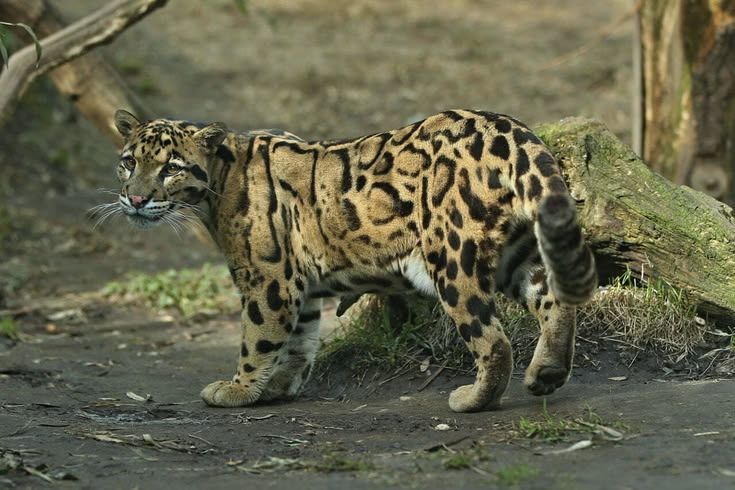
In the thick jungles of Northeast India, the clouded leopard prowls nearly in the shadows. With a short, muscular body, long canines and an iconic fur pattern, it’s one of the most unique wildcats in Asia but the species is also among the most poorly known predators in the country.
That invisibility can be a perilous delusion: Because most people will never see a clouded leopard in the wild, they may think the animal is safe. But in truth, the clouded leopards’ fate hinges on the state of large forested areas, which are becoming patchier as roads, human development and farm and forestry operations carve into the woods.
The new Clouded Leopard Conservation Action Plan in India aims to mitigate this challenge by taking conservation out of isolated protected areas. The plan, which targets habitat protection and restoration, scientific monitoring, and community participation, is based on 14 ‘priority conservation landscapes’ in the region.
A forest Issue, Not Only a Leopard problem
The future of the clouded leopard depends on the future of the forests of Arunachal Pradesh, Assam, Meghalaya, Nagaland, Mizoram, Manipur, Tripura, Sikkim and northern West Bengal. They are intimately associated with the forests.
The biggest danger is not really the direct killing of individual animals – it is the slow destruction of their habitat. When forests are fragmented, animals can no longer find prey, places to hide and mates. Roads and towns can also cut off movement between different groups.
Here’s why it’s important to have corridors. A protected forest, if surrounded by development, might maintain some suitable habitat, but it doesn’t necessarily provide enough space for a viable population over the long run. Corridors enable animals to move from one forest block to another, sharing genes and following the seasons for food and temperature.
Increase connectivity through landscape-level habitat restoration and corridor conservation. The action plan suggests creating habitat corridors for the purpose of restoring the landscape.
What conservation can actually do
1. Protect and reconnect forests
Our initial focus is to halt primary and mature forest depletion within historical ranges. It is up to conservations authorities to recognize sites that matter due to documented presence of leopards and that also bridge larger natural systems.
Restoration is required along degraded and damaged corridors, riverine forests and degraded edges. But plantations are not necessarily restoration. A plantation may have trees, but it will not have the prey base or structural complexity of a natural forest.
Effective restoration would include:
Clinging to natural forests before trying to restore them.
Restoring corridors between isolated habitats.
Minimising the damage to the environment caused by roads and infrastructure.
Designing crossings at all road intersects between key wildlife habitat areas.
Including climate projections in long-term landscape planning.
2. Find out where the leopards are
Clouded leopards are not easy to research. They are solitary, secretive and their habitat is dense forest that standard wildlife monitoring cannot be accurately obtained.
The updated conservation plan would include standardised monitoring of camera traps, occupancy surveys, genetic approaches and environmental DNA (or eDNA). These can provide information about where the species is found, how the population is tracking and what habitat the species needs to survive.
With camera traps it is also possible to find out about where animals have been, when and whether they were moving. Genetics can tell us whether populations that are isolated from each other are still interbreeding. EDNA could help detect the traces of animals from water, soil or other samples.
But technology is only valuable if monitoring is done repeatedly and openly. One image can show that a leopard occurs in an area but not that its numbers are safe. Conservation authorities should report on long-term results, develop common monitoring standards and use monitoring data to make adjustments to management.
3. Make local communities conservation partners
Home & Livelihoods It is possible that the areas that add to the risk of clouded leopards being trapped or snared are also home to people. Forest-dwelling communities rely on these habitats for farming, gathering forest resources, grazing and other survival activities. Conservation efforts that see local people solely as a threat will not work.
Community participation and sustainable livelihood activities are highlighted in the action plan. This is significant because local people are usually the first to spot the change in wildlife, illegal activity or destruction of habitats.
Community-based conservation could involve:
Employment and development of local monitors.
Supporting sustainable forest-based livelihoods.
Establishing quick-disaster response systems in places for conflict or livestock loss.
Equitably sharing ecotourism benefits when possible.
Connecting conservation planning with Indigenous and local ecological knowledge.
Making sure that restrictions on forest use are accompanied with viable options.
Engagement must be genuine not tokenistic. People can be involved in decisions and their protection should be providing demonstrable social or economic benefits.
Protection must extend beyond the forest
Hunting and trade in the clouded leopard or the loss of prey items are other real potential threats, which require robust anti-poaching and wildlife-crime prevention measures to be part of the recovery strategy.
Training, equipment and trained staff The plan emphasizes the need for training and equipment for frontline forest staff as well as more human resources. Capacity building and pilot projects using digital fieldmonitoring systems including M-STRIPES are included in the plan.
However, managing only for the leopard isn’t enough. A predator’s fate depends on the presence of its prey. To be truly effective, conservation must also preserve ungulates, primates, small animals and birds-and halt excessive hunting at all levels of the food chain.
As the forests are transborder in the North-eastern state, transnational cooperation will be crucial. The clouded leopard does not respect the political borders, and the lack of coordination among isolated national action plans might be insufficient to combat across the border, habitats, and wildlife-trafficking routes.
The real test is implementation
India’s policy on clouded leopards is better defined now. But the real task ahead is to implement the policy in quantifiable terms.
How to tell if a plan is any good? Outcomes should be as follows:
Whether forest loss declines in priority landscapes.
Whether corridors remain intact and usable.
Whether clouded-leopard populations are monitored consistently.
Whether illegal hunting and wildlife trafficking decrease.
Whether local communities receive tangible benefits.
Whether funding reaches field-level conservation work.
If there are changes to the project design to prevent the use of a critical habitat.
The clouded leopard is not threatened due to being beautiful and rare alone. It is threatened because its presence is indicative of some of India’s most ecologically critical forests.
The species will not be secured in a single reserve, in one survey, or on one international day. It will be secured by keeping connected forests, supporting patient science, and understanding that the lives of those who live with the forest must be central to its conservation.
The plan is a vital start for the region’s clouded leopards, but whether it is a success hinges on whether conservation of the spotted cats will be a paper exercise or a ground game.
References:
Wildlife Institute of India: “Conservation Action Plan for Caracal, Fishing Cat and Clouded Leopard(Technical Report 2026)” 4 August 2026.
Press Information Bureau, Ministry of Environment, Forest and Climate Change: “On International Clouded Leopard Day, India Strengthens Conservation through Dedicated Conservation Action Plan for the Wild Cat” 4 August 2026.
The Hindu: “Meghalaya Launches Mission to Protect Clouded Leopards” 5 August 2026.
ThePrint, PTI: “International Clouded Leopard Day: India Launches Conservation Action Plan for Species” 4 August 2026.
DD News: “Centre Rolls Out Conservation Action Plan for Clouded Leopard, Identifies 14 Priority Landscapes in Northeast” 4 August 2026.
Open: “Why Is India Launching a Special Plan to Save the Clouded Leopard?” 4 August 2026.
EastMojo: “Why India’s Plan to Conserve the Clouded Leopard Centres on the Northeast” 5 August 2026.
Ministry of Environment, Forest and Climate Change: “Wildlife Conservation in India: Centrally Sponsored Scheme and Species Recovery Programme” 20 August 2013, updated 2026.
Ministry of Environment, Forest and Climate Change: “Annual Report 2024–25” 2025.