
Is Ethanol Truly “Green”?: India’s ethanol drive and water/food security.

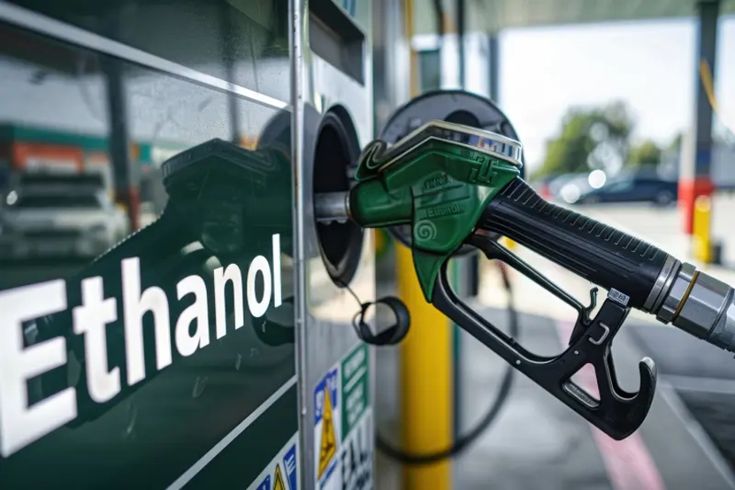
India has adopted E20 fuel from April 2026, which requires petrol to be mixed with 20% ethanol. India believes that this is a win-win policy: it reduces reliance on crude oil imports, minimizes certain vehicle emissions and enables farmers to sustain higher prices for their grain and sugar molasses, which the government uses to meet food-security needs such as the PDS and the national buffer stock. It insists that food security schemes receive top billing and that ethanol is mostly derived from surplus or substandard grain and molasses, so there is no conflict between “food and fuel”.
But as the programme expands, researchers, enviro-journalists, and opponents are asking tough questions about whether sugarcane, rice, and maize ethanol, as they are being produced in a water-stressed, food-scarce country, can even be labelled ‘green’. At its centre is the real cost of ethanol: the enormous water use of the feedstock, the groundwater stress it exacerbates, and the threat that moving food crops onto ethanol might make a tough year worse for future food and fodder.
The water footprint of ethanol made from crops is unfathomably huge. Around 3,600-3,850 litres of water are needed for a single litre of sugarcane-based ethanol, while rice-based ethanol can consume as much as 10,000-10,790 litres of water per litre of ethanol. Corn-based ethanol requires fewer litres of water, but a few thousand litres of water for every litre of ethanol is still far from insignificant.
Agriculture accounts for more than 85% of India’s freshwater use.
Most ethanol producing states – parts of Maharashtra, Uttar Pradesh, Karnataka, Punjab and Haryana – are located in areas with critically or over-exploited groundwater blocks, which provide drinking water and irrigation water to millions. Ethanol plants in these regions are already depleting groundwater resources that support local communities and could hinder their efforts to cope with rising water needs.
Meanwhile, replacing grains and sugarcane with ethanol prompts deep food-security worries. True, the government may insist it is only replacing “surplus” stocks. But the scale of deprivation is critical.
The higher the amount of rice, maize and sugarcane diverted to ethanol, the less there is to go into food, animal feed and processing.
Stock shortages and weak monsoons in a given year can push food and feed prices up among poor families and livestock-reliant communities. The recent decline in rice acreage has already sparked fears that more rice will be used to make ethanol. And a 2026 model of India’s E20 mandate concluded that almost all feasible proportions of various feedstocks will push up food prices and compete for land, water and fertiliser.
The Load is uneven This policy burdens only some farmers and villages. Water-guzzling sugar cane is grown mainly in the drought-prone districts of Maharashtra and Karnataka, where groundwater tables have been declining for years and farmers are routinely struggling with water shortages. Rice-based ethanol depletes the fertile land and lower groundwater levels in the Punjab-Haryana-western UP grain belt, while drinking water is a mere drop in the bucket of what groundwater needs. Effluents from some clusters of distilleries have been associated with local pollution as well.
The government defends this with the diversified feedstock basket of molasses, sugarcane juice, maize and only residual rice and the mandate’s injection of maize (0% in 2021-22 to 37% in 2025-26) to reduce sugarcane use. Researchers and critics point out that water use should be reckoned across the life cycle-from farm to fuel and at the plant gate, and what “surplus” really means when nutrition gaps, fodder needs and price swings are considered. The NITI Aayog’s own earlier ethanol roadmap underlined the importance of gradually shifting to less water-intensive and non-edible feedstocks, and think tanks such as ICRIER recommend E20 as a “long-term goal” while accepting smaller jumps to E15 during periods of high food and feed prices or limited supply.
So can ethanol be “green” in India? That depends less on the chemical composition and more on where and how it is made, and from what. It can help lower emissions and reduce trade dependence if there is a move to ethanol feedstocks less water-intensive than rice and sugarcane in regions with good water supply and set limits on new capacity in zones with over-extracted groundwater, and if clear standards stipulate that food and feed needs take precedence and the country pushes downstream on second-generation ethanol from agri-residues and waste rather than food crops.
But where ethanol is based on water-intensive rice and sugarcane in water-scarce areas, it may worsen groundwater levels, add to food-price spikes in cyclical years, and lock in an expensive water-hungry fuel in a climate-stressed country.
In that case, not all ethanol can be considered green in India.
References:
The Tribune India: “Centre assures 20% ethanol blending target has no impact on India’s food security or water stress” 20 July 2026
Mongabay India: “India’s ethanol push moves from the pump to the field, raising water and food questions” 28 July 2026
Outlook India: “Outlook Explains | Why India’s Ethanol Revolution Is Sparking Fresh Food And Water Concerns” 7 July 2026
Vajiram & Ravi (current affairs): “Ethanol Blending in India, Benefits, Challenges, Concerns” 1 August 2026
The Wire: “E-20 Explainer: What Are India’s Vehicles Drinking?” 24 August 2026
Water Today Magazine: “10,000 litres water for one litre of ethanol: India’s fuel push and groundwater crisis” 21 May 2026
Whalesbook: “India’s Ethanol Push Faces Water Scarcity Risks” 30 July 2026
Outlook Business: “Food, Water And Fuel: The Trade-Offs Behind India’s Ethanol Blending Policy” 31 July 2026
Outlook Business: “E20 Should Be Flexible, E15 Option Needed During Supply Shocks: ICRIER” 10 September 2026
The Tribune India: “Rice to ethanol policy endangers India’s food security, environmental commitments: experts” 12 June 2026
Business Standard: “Ethanol beyond E20: Why India’s clean fuel plan needs a water audit” 13 June 2026
Telangana Today: “Congress attacks E20 rollout, cites water and food security concerns” 6 August 2026
PLOS ONE (journal article): “India’s biofuel blending policy presents serious trade-offs with land, water and emissions” 8 July 2026
NewsHub.in.net (environment desk): “India Ethanol Expansion Faces Severe Groundwater Strain” 20 June 2026