
Waste is a Design Failure: Why the Future Economy Must Eliminate the Very Idea of Waste

Every morning, millions of garbage trucks leave cities carrying tonnes of waste to landfills, incinerators, and dumping sites.
For most people, this marks the end of a product’s journey.
Once discarded, it disappears from sight and, often, from memory.
But nature has never understood the concept of waste.
In a forest, fallen leaves become nutrients.
Dead trees become habitats for fungi, insects, and microorganisms.
Animal waste enriches the soil.
Nothing is permanently discarded because every output becomes the input for another process.
Human civilization, however, has created a different system.
We extract resources, manufacture products, consume them briefly, and dispose of them—often within days or months.
This “take–make–dispose” model has fuelled economic growth, but it has also created one of the defining environmental crises of the modern era.
The real problem is not simply the amount of waste we generate.
It is that we continue designing products destined to become waste.
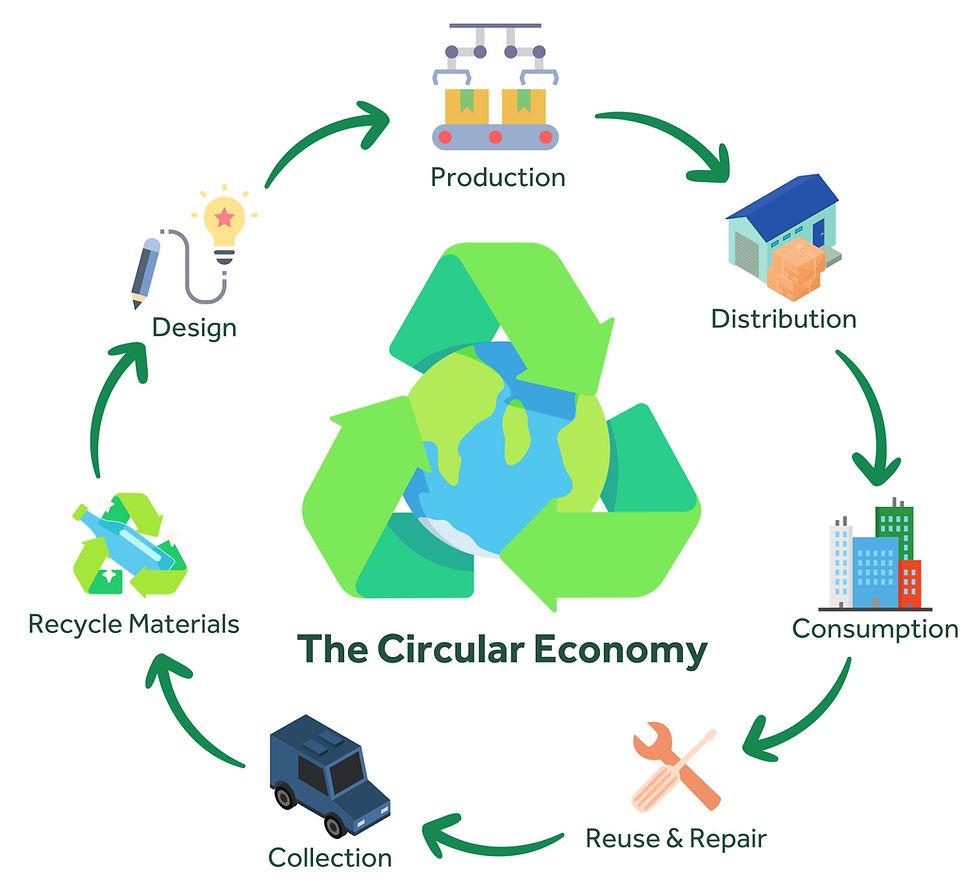
The Linear Economy: A System Designed to Lose Resources
Modern production follows a predictable sequence:
Extract → Manufacture → Consume → Dispose
Each stage removes materials from the Earth’s limited natural reserves.
Once discarded, these materials often lose their economic value, despite still containing useful resources.
Every landfill is therefore more than a waste site.
It is a repository of lost materials, wasted energy, and unrealized economic opportunity.
The environmental cost extends beyond overflowing dumpsites.
Every discarded product represents the water, energy, raw materials, transportation, and human labour invested in creating it.
Throwing something away means losing all of those embedded resources.
Nature’s Blueprint for Circularity
Natural ecosystems have operated according to circular principles for millions of years.
Nothing exists in isolation.
Everything becomes part of another cycle.
Leaves become compost.
Compost feeds microorganisms.
Microorganisms enrich soil.
Healthy soil supports forests.
Forests produce more leaves.
Nature demonstrates that long-term sustainability depends on continuous regeneration rather than continuous extraction.
A truly sustainable economy should learn from this principle.
From Consumers to Material Stewards
The circular economy asks society to rethink ownership and consumption.
Products should no longer be designed for disposal.
Instead, they should be designed to:
- Last longer.
- Be repaired.
- Be upgraded.
- Be shared.
- Be remanufactured.
- Be recycled into new products.
This transformation changes the role of consumers.
People no longer become end-users.
They become temporary custodians of valuable materials.
Designing Waste Out of the System
The most effective waste management strategy begins long before a product reaches a dustbin.
It begins at the design stage.
Manufacturers can reduce environmental impact by:
- Using fewer mixed materials.
- Designing products for easy repair.
- Creating modular components.
- Eliminating unnecessary packaging.
- Increasing recycled content.
- Developing take-back programmes.
When products are designed with their second life in mind, waste gradually disappears from the system.
Why Circularity is an Economic Opportunity
Many view environmental protection as a financial burden.
The circular economy presents a different perspective.
Recovering materials reduces dependence on virgin resources.
Repair industries generate skilled employment.
Product longevity lowers consumer costs.
Businesses develop new revenue models through maintenance, refurbishment, and remanufacturing.
Environmental responsibility and economic growth no longer have to compete.
They can reinforce one another.
HFN Solution Framework
Heavendoo Foundation believes the future of sustainability lies not only in managing waste, but in redesigning the systems that create it.
Short-Term
- Conduct community waste audits to identify reusable material streams.
- Launch educational campaigns explaining the principles of circular design.
- Partner with schools and colleges to promote repair, reuse, and responsible consumption.
Medium-Term
- Establish HFN Circular Resource Hubs where usable materials can be repaired, refurbished, or redistributed.
- Develop a digital platform connecting donors, repair experts, recyclers, and community organizations.
- Publish annual reports measuring material recovery rates instead of waste generation alone.
Long-Term
- Launch the HFN Circular Economy Index to evaluate cities and institutions based on resource efficiency.
- Build AI-powered material tracking systems using QR codes and digital product passports.
- Support policy recommendations encouraging Extended Producer Responsibility, product repairability standards, and circular manufacturing.
HFN Vision 2040
Heavendoo envisions a future where landfills become symbols of outdated thinking rather than permanent features of modern cities.
Products will be designed with multiple life cycles.
Materials will remain in continuous circulation.
Communities will measure success not by how much they consume, but by how little they waste.
In such a future, sustainability will no longer be defined by recycling alone.
It will be defined by intelligent design.
HFN Observation
“Waste is not created when a product reaches the landfill. Waste is created the moment a product is designed without a second life.”
The transition to a circular economy is more than an environmental necessity. It is a redesign of how humanity values resources, builds products, and defines prosperity.
HFN Research Questions
- Should every manufactured product carry a Digital Product Passport showing its environmental footprint and recyclability?
- Can Indian cities replace waste management targets with material recovery targets?
- How can AI, blockchain, and circular design work together to eliminate waste rather than simply manage it?