
Himalayan Salamander Under Threat – Impact of Tourism & Infrastructure On Fragile Himalaya Ecosystem.

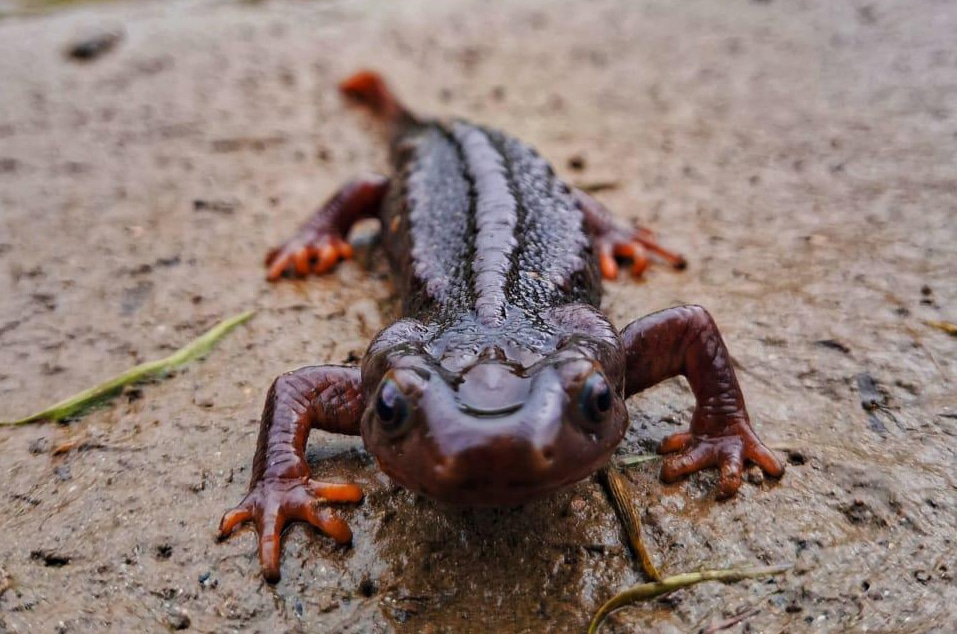
Every monsoon, when mist creeps across the Eastern Himalayas, the Himalayan salamander emerges from the forest floor to breed in small mountain wetlands. But these fragile breeding grounds are rapidly vanishing under pressure from tourism, construction, pollution and expanding infrastructure.
Species depends on the wetlands
Known by its scientific name Tylototriton himalayanus-and sometimes called the Himalayan newt-the species is dependent on pristine, undisturbed ponds known locally as pokhris. During the breeding season, the salamander performs an elaborate courtship dance before laying its eggs on semi-submerged aquatic plants. The following generation depends almost entirely on the health of these tiny wetlands.
Wetlands are already drained, filled and converted
The rapid proliferation of housing, hotels, roads and tourist infrastructure across the Darjeeling and Kurseong hills has caused many of the salamander’s traditional breeding habitats to become unsuitable. Several wetlands have been drained, filled and converted for construction, resulting in habitats that are unsuitable for many salamander populations.
“Most of these small wetland areas have been converted due to excessive housing and tourism in the Darjeeling hills,” Koushik Deuti, of the Zoological Survey of India, told Mongabay. He added that such habitat destruction means that conserving the salamander is inseparable from conserving water bodies on which local communities also depend.[1]
Tourism construction has been especially damaging in previously safe zones, such as India’s first salamander sanctuary, established in 1985. After parts of the site were cemented over and developed for tourism, the salamander disappeared from the protected area altogether.
“Many of these wetlands have been subjected to construction and habitat conversion, especially in Darjeeling,” Deuti said. “In Kurseong, the wetlands have been drained or altered due to unregulated tourism-related construction and land use change.”
Roads fragment migration pathways
Road construction has also become a major threat. During the monsoon, salamanders migrate between forested areas and breeding ponds. New roads can bisect their pathways, forcing the animals to cross traffic-packed roads.
Many salamanders are reportedly run over while crossing for breeding. Local residents have requested the construction of culverts-small passages built beneath roads-to allow the animals to cross safely, but these have not yet been erected along some routes.
Roads also fragment the salamander’s broader ecosystem, isolated breeding ponds and restrict salamander movements even if the habitat remains intact. This means that protecting individual wetlands isn’t enough. The entire ecosystem needs to be protected, with salamanders protected and the pathways made crossing-safe.
Pollution
The remaining wetlands are increasingly being polluted with wastewater, detergents, plastic waste, and other contaminants that are absorbed through the amphibian’s skin. As such, salamanders are considered an indicator species of wetland health. Its presence indicates a healthy aquatic ecosystem; its absence can signal wider environmental issues impacting insects, aquatic plants, birds, and local water supplies.
Altered land-use practices
The species is also being impacted by altered land-use practices, including in tea gardens and private properties. Currently, less than 10% of the species’ habitat falls within protected areas, said Deuti. The other 90% lies on private land, tea estates, and community lands, where development and tourism clash with conservation.
Decline in known sites
Forest authorities believe the species was once documented from more than 100 locations in the Darjeeling and Kurseong hills, but today, there are believed to be only 20 suitable sites. This decline wasn’t due to a single cause, but to…
– Loss of wetlands
– Conversion of wetlands
– Unplanned expansion of infrastructure
– Fragmentation of movement corridors by roads
– Plastic and other waste polluting wetlands
– Tourism-related infrastructure being built without ecological awareness
– Land use changes in tea estates and private land
– During breeding season, disturbances caused by tourism
The decline reflects an even bigger issue, the scientists said-mistakenly labeled as “small” or “unproductive,” many Himalayan ecosystems are actually essential habitat for rare species and the source of much of the water that sustains Himalayan communities.
Captive breeding is another step
The response to these threats has been a focus by the West Bengal Forest Department to restore degraded wetlands by clearing invasive weeds, removing waste, and constructing new ponds. A draft proposal has also been laid out to protect the Namthing Pokhri, Pokhriatar and Panch Pokhri as dedicated salamander conservation sites.
A separate proposal from the Kurseong Forest Division also seeks to establish a sanctuary for the Himalayan salamander, which would combine habitat restoration, scientific research, and community engagement. Breeding sites could be designated as no-go zones-particularly during the monsoon-when the animals are breeding.
The role of local communities
Local residents and youth groups are also being included through a project called “Screen to Green.” Conserative scientists believe local involvement will be key, as the species’ habitats lie outside traditional protected areas. If the species is to be preserved, the habitats-wetlands, forests, and corridors-must be protected, as well as the animals.
Responsible tourism, not degrowth
One way to maintain the tourism income and employment enjoyed by the Darjeeling hills, without destroying their wetlands, is to switch from haphazard tourism to ecologically responsible ecotourism. To do so, they suggest:
– restricting tourists from visiting wetlands during the monsoons
– preventing construction on wetlands
– protecting animal migration pathways with wildlife underpasses
– treating sewage and wastewaters before releasing them into wetlands
– banning use of detergents and plastics near wetlands
– banning ornamental fish and exotic species from ponds
– restricting the number of tourists to certain locations
– improving the quality of visitor facilities.
– involving local residents and young people in research and management
The future of the Himalayan salamander will depend on development that’s planned with ecological limits in mind. Protecting the Himalayan salamander means protecting its wetlands, migration routes, and forested corridors, too, not just “conserving a name.” What’s happening to the salamander is a harbinger of what’s happening to the water systems and biodiversity on which entire Himalayan societies depend, the scientists said.
References:
Mongabay India: “Tourism and Infrastructure Threaten Habitat of India’s Himalayan Salamanders” 20 July 2026
The Week: “How One Forest Officer Is Fighting to Save Himalayan Salamander” 18 September 2026
Millennium Post: “Darjeeling Set to Get India’s First Salamander Sanctuary” 18 September 2026
Frontline: “Whitley Award 2026 Honours India’s Unsung Conservation Heroes” 13 July 2026
EastMojo: “Darjeeling Conservationist Barkha Subba Wins Whitley Award 2026” 30 April 2026
DW: “Can a Himalayan Living Fossil Still Be Saved?” 15 September 2026
World Salamander Day: “Himalayan Salamander Conservation in Darjeeling, India” 5 April 2026
Climate East: “Challenges in Conserving the Himalayan Salamander in Darjeeling Hills” 31 December 2025
EastMojo: “Guardians of the Mist: The Himalayan Salamander’s Struggle for Survival” 4 October 2025
Khabarhub: “Endangered Himalayan Salamander in Crisis” 4 February 2026
ForumIAS: “Himalayan Salamander” 21 February 2026