
Can Cities Actually Restore Nature? Why simply planting trees isn’t always the answer.

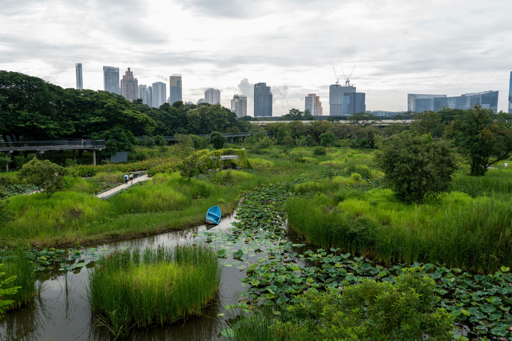
Cities are often presented as concrete landscapes that need to be “greened” through tree-planting drives. But restoring nature is more complicated than counting saplings. A successful urban restoration programme must protect existing ecosystems, choose vegetation suited to local conditions, restore wetlands and grasslands, connect fragmented habitats, and monitor whether biodiversity actually returns.
The question is no longer simply how many trees a city can plant. It is whether those trees belong in that landscape, whether they can survive without excessive water and maintenance, and whether they support a wider ecological system.
Beyond the tree-planting spectacle
In July 2026, Bengaluru witnessed one of India’s largest urban plantation drives, with nearly 1.5 million saplings planted across 240 acres. Organised by the Bangalore Development Authority, the initiative was promoted as a climate-resilience measure and was designed around the popular Miyawaki method of dense planting. Authorities also said the saplings would be geo-tagged and monitored.
Yet ecologists questioned whether such large-scale events measure the right thing. A one-day plantation drive can produce impressive numbers, but numbers alone do not reveal how many trees will survive, whether the site is ecologically suitable, or whether the plantation will develop into a functioning ecosystem.
Reports of saplings dying soon after Bengaluru’s drive also raised concerns about maintenance, accountability and whether public visibility had taken priority over long-term ecological outcomes. The initiative reportedly involved an estimated allocation of around ₹880 million, although the final expenditure was yet to be released at the time of reporting.
A forest is more than its canopy
A forest is not simply a collection of trees. It includes soil organisms, fungi, grasses, herbs, shrubs, insects, birds, mammals, water systems and the relationships connecting them.
This is one of the major criticisms of the Miyawaki model when it is applied without adaptation. The method can produce dense tree cover quickly, but its emphasis on closely planted trees may suppress herbs and grasses by blocking sunlight from reaching the forest floor. Dense planting can also increase competition for water and nutrients, particularly during the early stages of growth.
The scientific evidence behind some of the method’s widely promoted claims is also limited. A 2025 systematic review found stronger evidence for rapid early growth and canopy development, but little empirical evidence proving that Miyawaki forests become self-sustaining after three years. Evidence that they consistently support greater biodiversity or store substantially more carbon than other restoration methods remains limited because of the lack of long-term comparative studies.
This does not mean that Miyawaki plantations are useless. Studies of young Miyawaki forests in Bengaluru and Palakkad found that carbon storage increased as the plantations matured. However, rapid tree growth should not automatically be described as ecological restoration.
The wrong trees can create new problems
The ideal vegetation for a city depends on its climate, soil, water availability, built environment and original ecology.
Bengaluru, for example, is not naturally a rainforest. Its landscape includes dry tropical forests, thorn scrub, granite outcrops and grass-rich semi-arid savannas. Planting dense, water-intensive woodland in such a landscape may place additional pressure on groundwater and replace open ecosystems that already support specialised birds, insects and plants.
Even trees that are technically native may be inappropriate for a particular site. A native species from a moist forest may not be suitable for a dry urban grassland. Similarly, a tree that provides shade in one location could obstruct airflow or trap pollution in a narrow, congested street.
Research and urban-planning experts have warned that dense canopies can sometimes reduce wind movement and keep heat or pollutants close to the ground. In such locations, shrubs, planting beds, green walls or carefully designed vegetation may be more effective than large trees.
The goal, therefore, should not be “trees everywhere”. It should be the right vegetation in the right place.
What genuine urban restoration looks like
A more scientific approach would begin by asking what ecological problem a city is trying to solve.
To reduce heat, planners may need shade trees, reflective surfaces, water-sensitive design and better ventilation.
To reduce flooding, restoring wetlands, lakes, streams and permeable soil may be more effective than planting trees beside roads.
To support pollinators, cities need flowering plants, native grasses and pesticide-free habitats.
To protect birds and small animals, fragmented green spaces must be connected through ecological corridors.
To improve air quality, vegetation must be selected according to street width, traffic, wind movement and pollution levels.
To conserve biodiversity, existing natural areas should be protected before new plantations are created.
A 2024 study on urban biodiversity emphasised that cities should conserve and restore a broad range of native ecosystems rather than focusing on only one type of green space. It also recommended ecological connections, biodiversity monitoring, science-based planning and participation from governments, researchers, businesses and local communities.
Several cities have adopted this broader approach. Singapore, for instance, combines habitat restoration with ecological surveys, species-recovery programmes and the creation of nature corridors. Edmonton has incorporated ecological networks into urban planning, while Durban protects interconnected open spaces through its metropolitan conservation system.
These examples show that urban nature restoration is not only a landscaping project. It is a planning, governance and public-policy project.
Protect first, plant second
One of the most important principles of urban conservation is that existing nature should not be destroyed and then replaced with plantations elsewhere.
Old trees, wetlands, grasslands, lakes and natural scrub often provide ecological benefits that young saplings cannot immediately reproduce. Mature habitats may support established food webs, store carbon, regulate water and provide shelter for species that cannot survive in newly planted areas.
This is why a city can be planting trees while still losing nature. If construction continues to eliminate wetlands, natural grasslands and mature tree cover, plantation campaigns may function as compensation in public relations rather than restoration in ecological terms.
A credible programme must therefore include:
Protection of existing habitats.
Site-specific species selection.
A mix of trees, shrubs, herbs and grasses.
Restoration of soil and water systems.
Long-term watering and maintenance.
Control of invasive species where necessary.
Community participation.
Public reporting of survival rates and biodiversity outcomes.
Monitoring over decades, not merely during the first planting season.
Can cities restore nature?
Yes, but they cannot do it through sapling counts alone.
Cities can restore parts of their ecological systems when they understand the landscape they have inherited and plan accordingly. In some places, that may mean a shaded avenue of mature trees. In others, it may mean restoring a wetland, protecting a rocky outcrop, allowing native grassland to grow, creating a pollinator meadow or reconnecting isolated habitats.
The most useful measure of success is not how many plants were put into the ground on a single day. It is whether, years later, the site has healthy soil, surviving vegetation, returning wildlife, functioning water systems and benefits that are shared fairly by residents.
Urban nature should not be treated as decoration added after development. It must become part of how cities are designed, built and governed. As Bengaluru’s plantation debate demonstrates, the future of urban restoration will depend less on planting more and more on restoring wisely.
References:
Mongabay India: “Cities need tailored restoration, not mass tree planting” 17 July 2026
Mongabay: “Popular Miyawaki reforestation method lacks evidence, study finds” 13 May 2026
Rega-Brodsky et al., U.S. Forest Service: “Urban Biodiversity: State of the Science and Future Directions” 2022
Cities journal: “Cities in Nature” 22 April 2024
Springer Nature: “Urban Refugia Sheltering Biodiversity Across World Cities” 2023
BioScience: “Planning for the Future of Urban Biodiversity: A Global Review of City-Scale Initiatives” 1 April 2017
Euronews: “Why Greening Our Cities Is Not Just About Planting More Trees” 24 September 2025
BBC Future: “The Tiny Forests That Thrive in Cities” 11 September 2025
World Economic Forum: “Why Urban Nature Restoration Has Become a Strategic Priority for Cities” 22 April 2025
Journal of Applied Ecology: “Evaluating the Evidence for the Miyawaki Method of Urban Afforestation” December 2025
Nature Restoration Law, European Commission: “Urban Ecosystem Restoration and Green Space Targets” 2024
The Tree Council: “Tiny Forests: Research and Evidence Review” 2023