
Farakka Barrage: Floodgates open for debate.

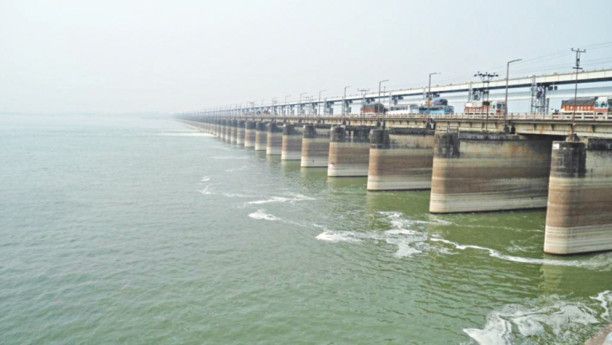
Bihar has once again called for the opening of all gates of Farakka Barrage, citing an unprecedented increase in Ganga’s water level and devastating floods across the state. The leaders claim it could provide a swift drain for the water that threatens to devastate riverine areas further downstream.
The recent appeal comes amid a dire water crisis where river levels have breached all danger marks at multiple points in Bihar. The state government’s reasoning for fully opening the barrage is simple: to enhance flow across the river and prevent its spill over in already afflicted regions.
The incident is also the catalyst for an ever-recurring battle of narratives over the role of Farakka Barrage in the India-Bangladesh treaty for equitable distribution of Ganga waters, with Bihar leaders arguing strongly that it should factor in the state’s demands in the impending renegotiation of the treaty, something that the central government says would take place during the treaty’s renewal.
Situated on the Ganga in West Bengal, the Farakka Barrage was originally intended for diversion to the Hooghly in order to increase the flow there for navigational benefits and reduce siltation at Kolkata port. Over the past several decades, however, it has become far more than just a simple concrete structure for, while its initial aims remain, Farakka stands as a sentinel that touches upon matters beyond its primary intention, as evident in the present context with its implications on flood control, state politics, riverine ecology and interstate waters management.
That even minor decisions with respect to river traffic can influence river levels at multiple sites makes Farakka a touchy and often politicized subject in monsoon. As any decision that aims to alleviate a difficult situation in one particular region is liable to exacerbate it elsewhere, opening or shutting down the floodgates of a barrage naturally attracts heated discussion among the two state administrations.
On ground this is also an example of the interplay between climate stress and governance. With increasingly erratic rain patterns, a rapid rise in water levels and deep rooted river waters disputes with Bangladesh, Farakka has become one of the most important national issues in monsoon, even if its impact remains acutely concentrated in two specific states.
There is little denying that the barrage remains critical due to its role in dictating not just water flows but flood patterns across vast reaches of Eastern India. This alone has been a sufficient reason for politicians as well as writers to react instantly each time a row escalates, or levels shift, or floods deepen in Bihar.
Reference:
1. The Times of India – Samrat urges Bengal CM to open all Farakka gates. 22 August 2026.
2. ANI News – Bihar: Samrat Choudhary urges Bengal CM to open all Farakka Barrage gates amid rising Ganga level. 24 August 2026
3. Asianet Newsable – Farakka Barrage Treaty renewal must be reconsidered. 19 August 2026.
4 News18 – Suffered For 30 Years: Why Bihar Is Raising Alarm Ahead Of India-Bangladesh Ganga Treaty Review. 25th August 2026.