
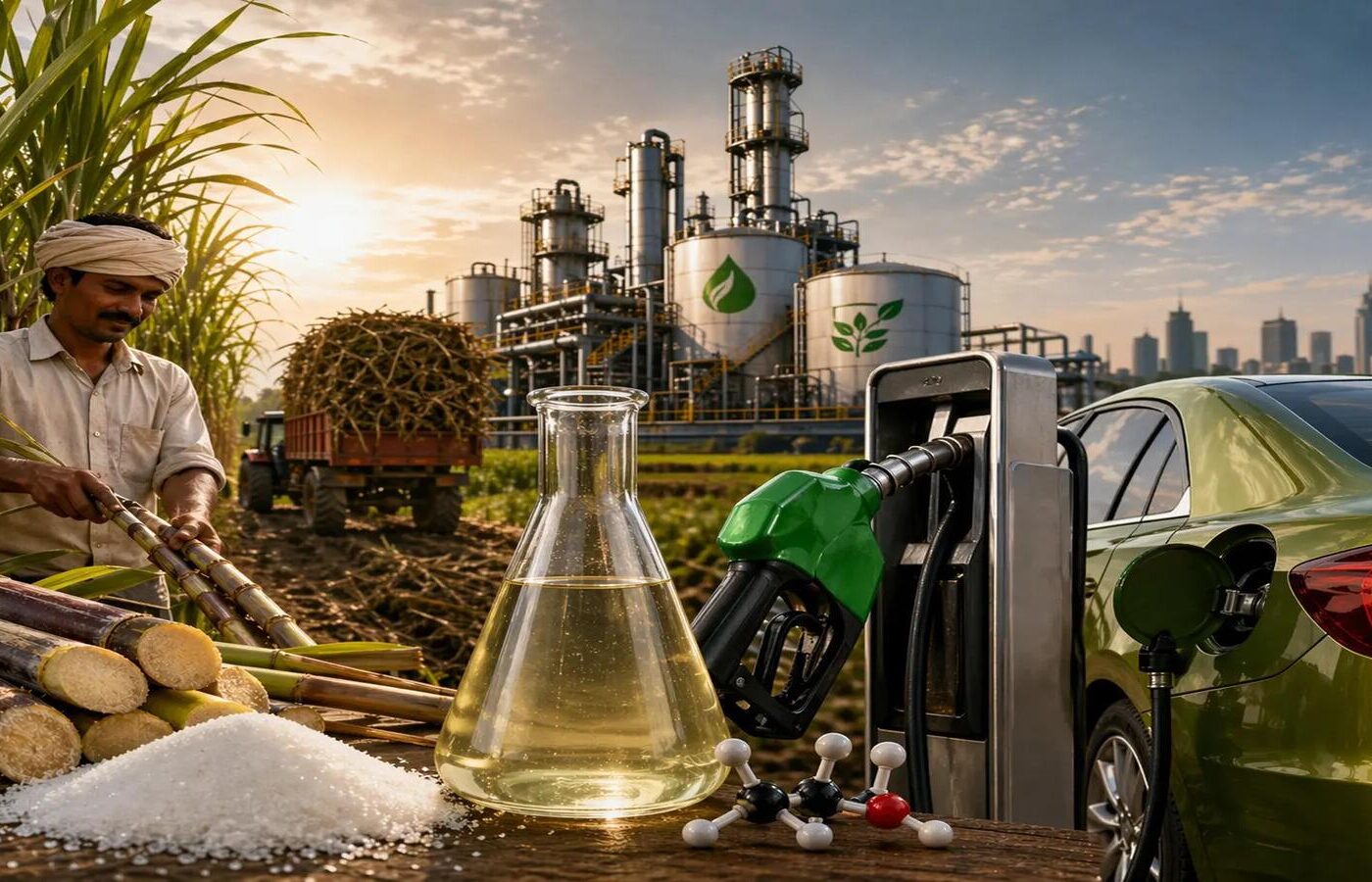
The Ethanol Debate: Is Green Fuel Solving Climate Change or Creating a New Environmental Challenge?

Around the world, nations are racing to reduce greenhouse gas emissions and decrease their dependence on fossil fuels. Electric vehicles, hydrogen fuel, sustainable aviation fuel, and biofuels have emerged as key pillars of the global energy transition.
In India, one of the most ambitious initiatives has been the Ethanol Blending Programme (EBP), which aims to mix ethanol with petrol to reduce crude oil imports, strengthen energy security, and lower transportation emissions.
At first glance, ethanol appears to be an ideal solution.
It is produced from renewable agricultural resources, burns cleaner than conventional petrol, and supports rural economies by creating additional markets for farmers.
Yet behind this promising narrative lies a more complex environmental question.
Can a fuel truly be called “green” if producing it places increasing pressure on land, water, and food systems?
The answer depends not only on how ethanol is used, but on how it is produced.
Understanding Ethanol
Ethanol is an alcohol-based biofuel produced through the fermentation of plant-based sugars and starches.
Globally, ethanol is commonly produced from:
- Sugarcane
- Maize (Corn)
- Sugar beet
- Wheat
- Molasses
- Agricultural residues (Second-Generation Ethanol)
Unlike petroleum, ethanol originates from biological materials that can be regrown, making it a renewable source of energy under appropriate management.
When blended with petrol, ethanol can improve combustion efficiency and reduce certain vehicle emissions.
For countries heavily dependent on imported crude oil, this offers both environmental and economic advantages.
Why India is Accelerating Ethanol Blending
India imports a significant share of its crude oil requirements, exposing the economy to volatile international markets.
Expanding domestic ethanol production aims to achieve several national objectives simultaneously:
- Reduce dependence on imported fossil fuels.
- Improve energy security.
- Create additional income opportunities for farmers.
- Lower tailpipe emissions from road transport.
- Support national climate commitments.
From a policy perspective, ethanol represents more than a fuel—it is part of a broader strategy linking agriculture, energy, and environmental sustainability.
The Water Question
One of the most important environmental debates surrounding ethanol concerns water.
Many first-generation ethanol feedstocks, particularly sugarcane, require substantial amounts of water for cultivation.
In regions already experiencing groundwater depletion or irregular rainfall, expanding water-intensive crops can place additional stress on freshwater resources.
The challenge is not ethanol itself.
The challenge is producing ethanol in landscapes where water availability is already under pressure.
A sustainable biofuel strategy must therefore consider the water footprint of every litre produced.
Food or Fuel?
Another global concern involves competition between food production and fuel production.
When agricultural land is increasingly allocated to energy crops, policymakers must balance multiple priorities:
- Food security
- Farmer livelihoods
- Renewable energy
- Water availability
- Biodiversity conservation
If productive farmland shifts excessively toward fuel production, food supply chains may experience increased pressure during periods of drought or crop failure.
Finding the right balance remains one of the most important policy questions in the future of biofuels.
Looking Beyond Tailpipe Emissions
Ethanol is often promoted because it can reduce emissions from vehicle exhausts.
However, environmental sustainability should be evaluated across the entire life cycle of the fuel.
This includes:
- Land preparation
- Irrigation
- Fertilizer use
- Crop harvesting
- Transportation
- Industrial processing
- Fuel distribution
A complete Life Cycle Assessment (LCA) provides a more accurate picture of ethanol’s overall environmental impact than tailpipe emissions alone.
This systems-based approach is increasingly becoming the global standard for evaluating sustainable fuels.
The Future Lies in Second-Generation Biofuels
The next chapter of biofuel development may not depend on food crops at all.
Second-generation (2G) ethanol is produced from agricultural residues and organic biomass that would otherwise be discarded or burned.
Potential feedstocks include:
- Rice straw
- Wheat straw
- Bagasse
- Bamboo
- Forestry residues
- Organic municipal waste
These materials reduce pressure on agricultural land while also helping manage crop residue that often contributes to seasonal air pollution.
Advanced biofuels therefore represent an opportunity to strengthen both energy security and environmental sustainability.
HFN Solution Framework
Heavendoo Foundation believes the future of biofuels should be guided by science, resource efficiency, and ecological responsibility.
A successful transition requires balancing climate goals with water conservation, biodiversity protection, and food security.
Short-Term
- Promote public awareness on the environmental trade-offs of different biofuels.
- Encourage efficient irrigation techniques for biofuel feedstock cultivation.
- Support transparent reporting of water use in ethanol production.
Medium-Term
- Promote research into second-generation ethanol using agricultural residues.
- Encourage life cycle assessments for all large-scale biofuel projects.
- Develop regional sustainability guidelines based on local water availability and crop suitability.
Long-Term
- Establish the HFN Sustainable Biofuel Index evaluating fuels based on carbon emissions, water footprint, land use, biodiversity impact, and circular resource utilization.
- Develop AI-powered crop planning systems that recommend suitable biofuel feedstocks without compromising food production.
- Build GIS-based environmental monitoring platforms to assess long-term impacts of biofuel expansion.
HFN Vision 2040
Heavendoo envisions a future where renewable energy solutions do more than reduce carbon emissions.
They must also protect freshwater resources, strengthen biodiversity, preserve healthy soils, and enhance food security.
A truly sustainable energy transition is one that benefits both people and the ecosystems upon which they depend.
HFN Observation
“A fuel should not be judged only by the emissions coming out of an engine. It should also be judged by the resources consumed before it ever reaches the fuel tank.”
The future of biofuels will not be determined by whether they are renewable, but by whether they are produced responsibly. Sustainability begins long before combustion—it begins in the fields, the water resources, and the policies that shape how energy is produced.
HFN Research Questions
- Should every litre of biofuel carry a publicly available carbon and water footprint label?
- Can second-generation ethanol become the primary biofuel without competing with food production?
- How can AI, satellite monitoring, and precision agriculture improve the sustainability of India’s biofuel transition?
- Should national biofuel policies measure ecological impact alongside energy security?