
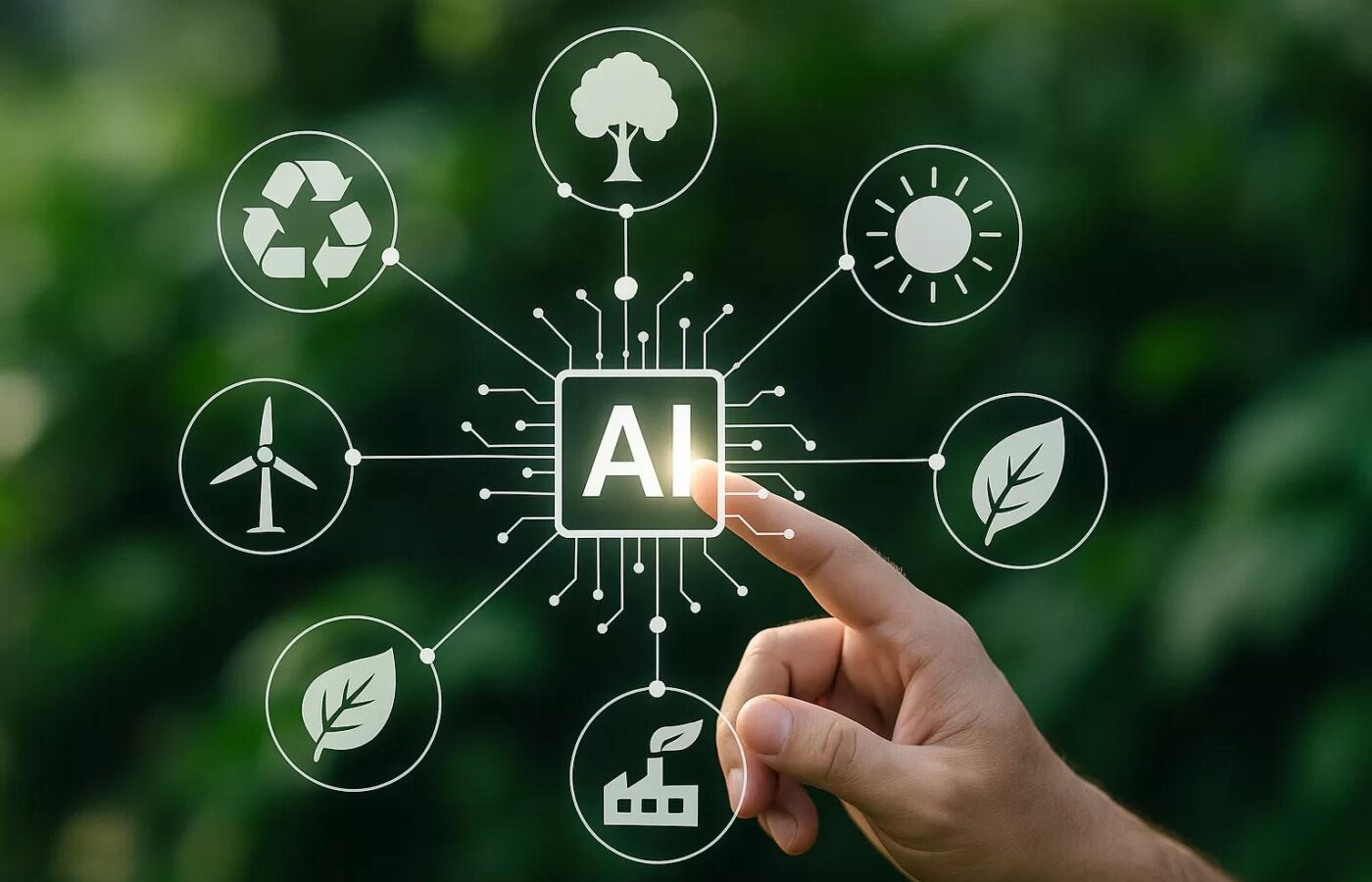
The Hidden Environmental Cost of Artificial Intelligence: Is the Digital Revolution Becoming an Ecological Challenge?

Artificial Intelligence is rapidly transforming the modern world.
It writes code, diagnoses diseases, predicts weather, drives scientific research, and assists millions of people with everyday tasks. Governments are investing billions in AI infrastructure, businesses are integrating intelligent automation into their operations, and universities are redesigning education around the technologies of tomorrow.
To many, AI represents the next industrial revolution.
But every revolution comes with an environmental footprint.
Behind every AI-generated response, every image created, and every model trained lies a vast physical infrastructure that is rarely seen by the public. Massive data centres, thousands of high-performance processors, cooling systems, transmission networks, and continuous electricity supplies work together every second to keep artificial intelligence operational.
As AI adoption accelerates across the globe, an important environmental question is beginning to emerge.
Can the digital revolution remain sustainable if the infrastructure powering it places increasing pressure on energy systems, freshwater resources, and critical minerals?
The future of Artificial Intelligence will depend not only on how intelligent it becomes, but also on how environmentally responsible it is.
The Invisible Infrastructure Behind Every AI Response
Many people think of Artificial Intelligence as software.
In reality, AI is deeply connected to physical infrastructure.
Every AI model depends upon:
- High-performance Graphics Processing Units (GPUs)
- Large-scale data centres
- High-speed networking systems
- Cloud computing infrastructure
- Continuous electricity supply
- Advanced cooling technologies
Unlike traditional software, modern AI systems require enormous computational resources for both training and daily operation.
Every prompt submitted to an AI platform activates thousands of electronic components working simultaneously inside specialised computing facilities distributed across the world.
Artificial Intelligence may appear virtual—but its environmental footprint is very real.
Energy: The New Fuel of Artificial Intelligence
Electricity has become the primary resource powering the AI revolution.
Training large language models requires extensive computational processing that may continue for weeks or even months.
Once deployed, these models continue consuming electricity every time users generate text, analyse images, or perform complex reasoning tasks.
As global AI adoption expands across healthcare, education, finance, manufacturing, and government services, electricity demand from digital infrastructure is expected to grow significantly.
The environmental impact of this growth depends largely on how that electricity is generated.
Data centres powered by renewable energy produce a different environmental outcome than those relying heavily on fossil fuels.
For this reason, energy source matters as much as energy consumption.
Water: The Hidden Resource Behind Artificial Intelligence
Electricity is not the only resource required to operate AI.
Large data centres generate considerable heat.
Without effective cooling, servers cannot function safely.
Many facilities therefore rely on sophisticated cooling systems, some of which require substantial quantities of freshwater to maintain operational temperatures.
This creates an important sustainability challenge.
As AI infrastructure expands into regions already experiencing water stress, balancing technological growth with responsible water management becomes increasingly important.
The digital economy is therefore connected not only to energy security, but also to freshwater security.
The Mineral Challenge
Every AI server contains materials extracted from the Earth.
Copper carries electricity.
Silicon forms advanced processors.
Lithium, nickel, cobalt, and rare earth elements support energy storage, electronics, and manufacturing.
Demand for these minerals continues increasing as digital infrastructure expands worldwide.
Mining these resources brings its own environmental considerations, including land disturbance, biodiversity impacts, water use, and waste generation.
The future of sustainable AI therefore begins long before a computer is switched on.
It begins inside the mines that provide the materials powering digital technologies.
Artificial Intelligence Can Also Protect Nature
Despite these challenges, Artificial Intelligence may become one of the most powerful tools ever developed for environmental conservation.
Around the world, researchers are already using AI to:
- Detect illegal deforestation from satellite imagery.
- Predict floods before they occur.
- Identify forest fires during their earliest stages.
- Monitor wildlife populations.
- Improve precision agriculture.
- Optimise renewable energy systems.
- Track pollution across cities and rivers.
The same technology that consumes resources also has the potential to protect them.
The challenge is ensuring that AI’s environmental benefits exceed its environmental costs.
Towards Green Artificial Intelligence
The next phase of AI development must move beyond performance alone.
Future systems should also be evaluated according to:
- Energy efficiency.
- Water efficiency.
- Hardware longevity.
- Renewable energy integration.
- Carbon intensity.
- Material circularity.
Just as buildings increasingly follow green construction standards, AI infrastructure may eventually require environmental sustainability standards of its own.
The future will belong not only to powerful AI—but to responsible AI.
HFN Solution Framework
Heavendoo Foundation believes Artificial Intelligence should become an environmental partner rather than an environmental burden.
Digital innovation and ecological restoration must evolve together.
Short-Term
- Publish public awareness resources explaining the environmental footprint of digital technologies.
- Encourage responsible digital consumption and cloud resource optimisation.
- Promote sustainability discussions within AI education programmes.
Medium-Term
- Develop the HFN Green AI Assessment Framework to evaluate AI systems based on energy, water, carbon, and material efficiency.
- Collaborate with universities to research environmentally sustainable AI infrastructure.
- Encourage organisations to disclose environmental indicators for large-scale AI deployments.
Long-Term
- Launch the HFN Green AI Index, benchmarking AI infrastructure using lifecycle environmental metrics.
- Develop AI-powered platforms supporting biodiversity monitoring, climate adaptation, and ecosystem restoration.
- Promote environmental certification standards for sustainable data centres powered by renewable energy and circular resource management.
HFN Vision 2040
Heavendoo envisions a future where Artificial Intelligence becomes one of humanity’s greatest tools for restoring the natural world.
Technology should not merely automate human work.
It should help regenerate forests, secure freshwater resources, protect biodiversity, improve environmental governance, and strengthen climate resilience.
The next generation of AI must not only become smarter.
It must become ecologically intelligent.
HFN Observation
“The future question is no longer whether Artificial Intelligence is intelligent enough. The real question is whether humanity is wise enough to build Artificial Intelligence that respects the ecological limits of our planet.”
Every technological revolution reshapes society.
The AI revolution now has an opportunity to do something unprecedented—not only accelerate economic progress, but also accelerate environmental restoration.
HFN Research Questions
- Should AI companies publicly disclose the energy, water, and carbon footprint of every large AI model?
- Can renewable-powered data centres become the global standard for artificial intelligence infrastructure?
- How can AI itself help restore forests, monitor biodiversity, and strengthen climate resilience?
- Should environmental sustainability become a mandatory performance indicator for future AI systems alongside speed and accuracy?