
Can Tree Roots Solve the Water Crisis?- Why Rain Won’t Fix the Water Crisis

Every monsoon season, headlines celebrate rainfall totals. Governments monitor reservoirs, weather agencies track precipitation, and citizens eagerly wait for the first downpour to cool scorching cities.
Yet a dangerous misconception continues to dominate public thinking: rainfall alone does not solve a water crisis.
The True Measure of Water Security
The true measure of water security is not how much rain falls from the sky—it is how much water the ground can actually store. Across rapidly urbanizing regions, concrete roads, parking lots, buildings, and paved surfaces have quietly transformed our cities into giant waterproof shields. Rain still falls, but increasingly, it has nowhere to go.
This invisible crisis is accelerating groundwater depletion beneath our feet, threatening the long-term water security of millions.
The Concrete Trap: When Rain Becomes Runoff
Historically, rainwater naturally seeped into the soil. Forests, grasslands, and open land acted as giant recharge systems, allowing water to slowly travel downward and replenish underground aquifers. Modern cities operate very differently.
As urban expansion replaces natural landscapes with concrete and asphalt, rainfall is rapidly diverted into drains and stormwater channels. According to data from the US Environmental Protection Agency (EPA), a typical urban area with 75% to 100% impervious surfaces turns up to 55% of rainfall into immediate surface runoff, compared to less than 10% in natural, forested landscapes. Instead of infiltrating the soil, enormous volumes of water are pushed away from the land within minutes.
The result is a paradoxical situation:
- Cities experience severe flash flooding during heavy rainfall.
- Groundwater levels continue to decline at alarming rates.
- Water shortages worsen despite seasonal rains.
United Nations water reports indicate that dozens of the world’s mega-cities are currently depleting their aquifers far faster than nature can replenish them, with water tables in some rapidly urbanizing hubs dropping by 1 to 3 meters every single year. This phenomenon has become one of the defining environmental challenges of the 21st century.
Nature’s Underground Engineers
While most people associate trees with oxygen production and shade, their most overlooked contribution exists beneath the surface. Tree root systems act as natural groundwater infrastructure.
As roots penetrate deep into the soil, they create thousands of microscopic pathways that improve soil porosity and water infiltration. Hydrological studies show that soil anchored by mature tree root systems can boast water infiltration rates 10 to 20 times higher than compacted urban lawns or bare soil. These underground channels allow rainwater to travel deeper into the earth instead of being lost as surface runoff.
The process generates multiple environmental benefits:
- Improved Water Infiltration: Root networks break up compacted soil, allowing water to move downward more efficiently.
- Reduced Urban Flooding: By slowing the movement of rainwater across the surface, trees reduce pressure on drainage systems during storms. Urban canopies can also intercept between 10% and 40% of rainfall before it even hits the ground, significantly reducing peak stormwater surges.
- Groundwater Recharge: A greater percentage of rainfall reaches underground aquifers, helping replenish depleted water reserves.
- Enhanced Soil Stability: Roots strengthen soil structure, reducing erosion and preserving long-term land health.
In essence, every mature tree functions as a living water management system.
The Compounding Cost of Tree Loss
When cities remove trees faster than they replace them, the consequences compound over time. Fewer trees lead to:
- Lower groundwater recharge rates.
- Increased surface runoff.
- Higher flood risks.
- Greater soil degradation.
- Increased urban temperatures via the Urban Heat Island effect.
The loss of urban tree cover is therefore not merely a biodiversity issue—it is a water security issue. Every hectare of lost green cover reduces a city’s natural ability to capture and store rainfall.
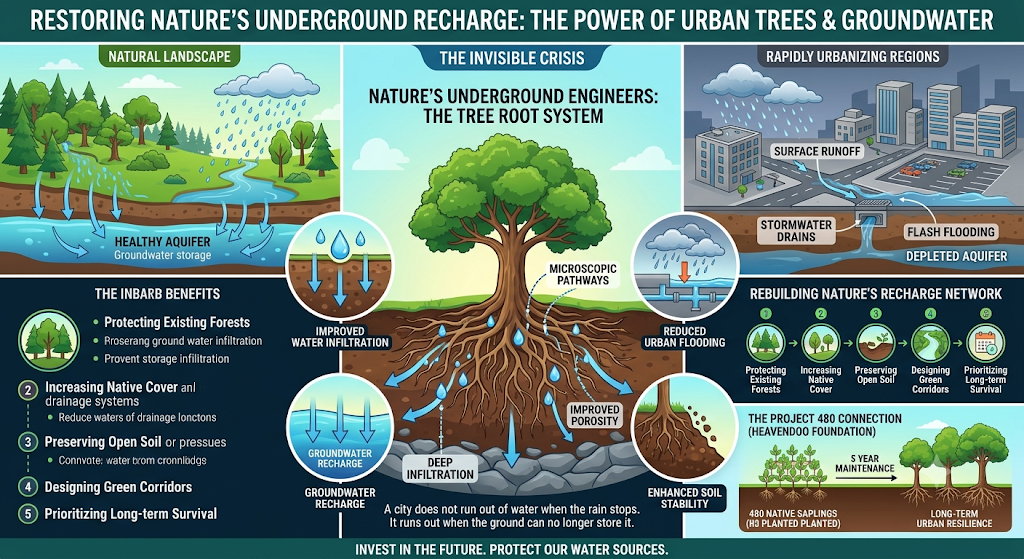
*Image is Ai generated
Rebuilding Nature’s Recharge Network
Addressing groundwater depletion requires more than constructing new reservoirs or expanding artificial water supply systems. Cities must actively restore the natural infrastructure that supports groundwater recharge.
This includes:
- Protecting existing urban forests.
- Increasing native tree cover.
- Preserving open soil zones.
- Designing green corridors that allow water infiltration.
- Prioritizing long-term tree survival rather than short-term plantation numbers.
The objective should not simply be planting more trees. The objective should be creating self-sustaining ecosystems capable of restoring natural hydrological cycles.
The Project 480 Connection
At Heavendoo Foundation, Project 480 was designed around this long-term philosophy. By planting 480 native saplings and committing to five years of structured maintenance, the initiative focuses on developing mature root systems that can contribute meaningfully to groundwater recharge, soil health, and urban climate resilience.
Arboricultural data confirms that the first 3 to 5 years are the most critical for a tree’s root establishment; structured care during this window increases long-term survival rates past 80%, ensuring the saplings actually grow to become functional water-recharge assets.
The environmental value of a tree is not measured on plantation day. Its true impact emerges years later, when its roots begin transforming the landscape beneath our feet.
HFN Observation: The Underground Bank Account “A city does not run out of water when the rain stops. It runs out of water when the ground can no longer store it.”
For decades, urban planning has focused on moving water away as quickly as possible. The future demands a different approach—one that prioritizes keeping water where it falls. Every healthy tree root is an investment in that future.